
Pulsar3D Hydra
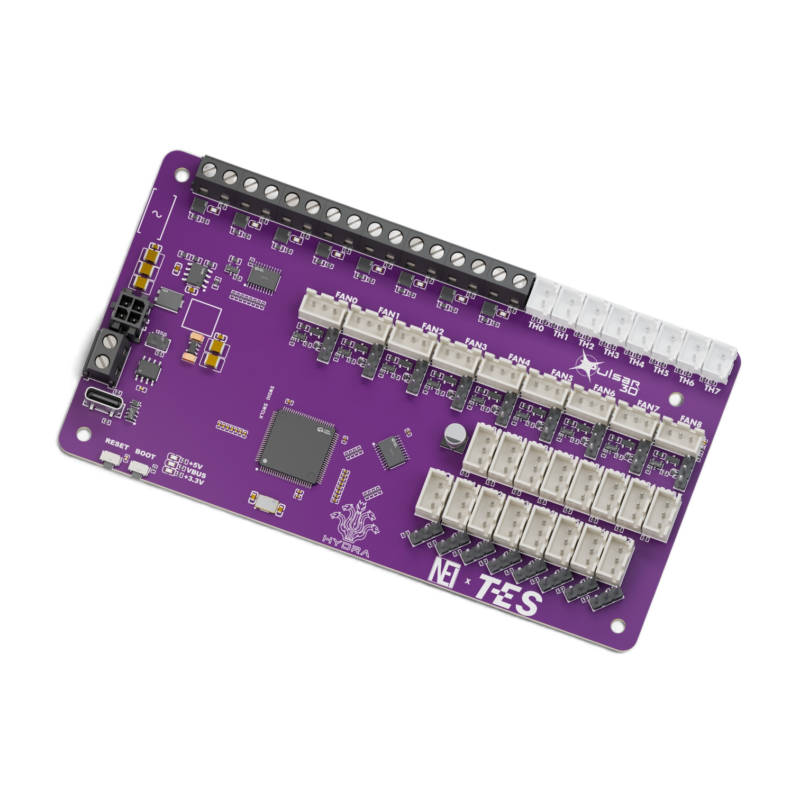
Run up to 8 hotends from a single board. Hydra by Pulsar3D (Designed by Tröndle Embedded Systems (TES)) is a dedicated Klipper control board for hotend-changer and toolchanger printers. It puts the heating, cooling, lighting and sensing for every tool on one 140 × 75 mm PCB, so you don’t need a separate board for each hotend.
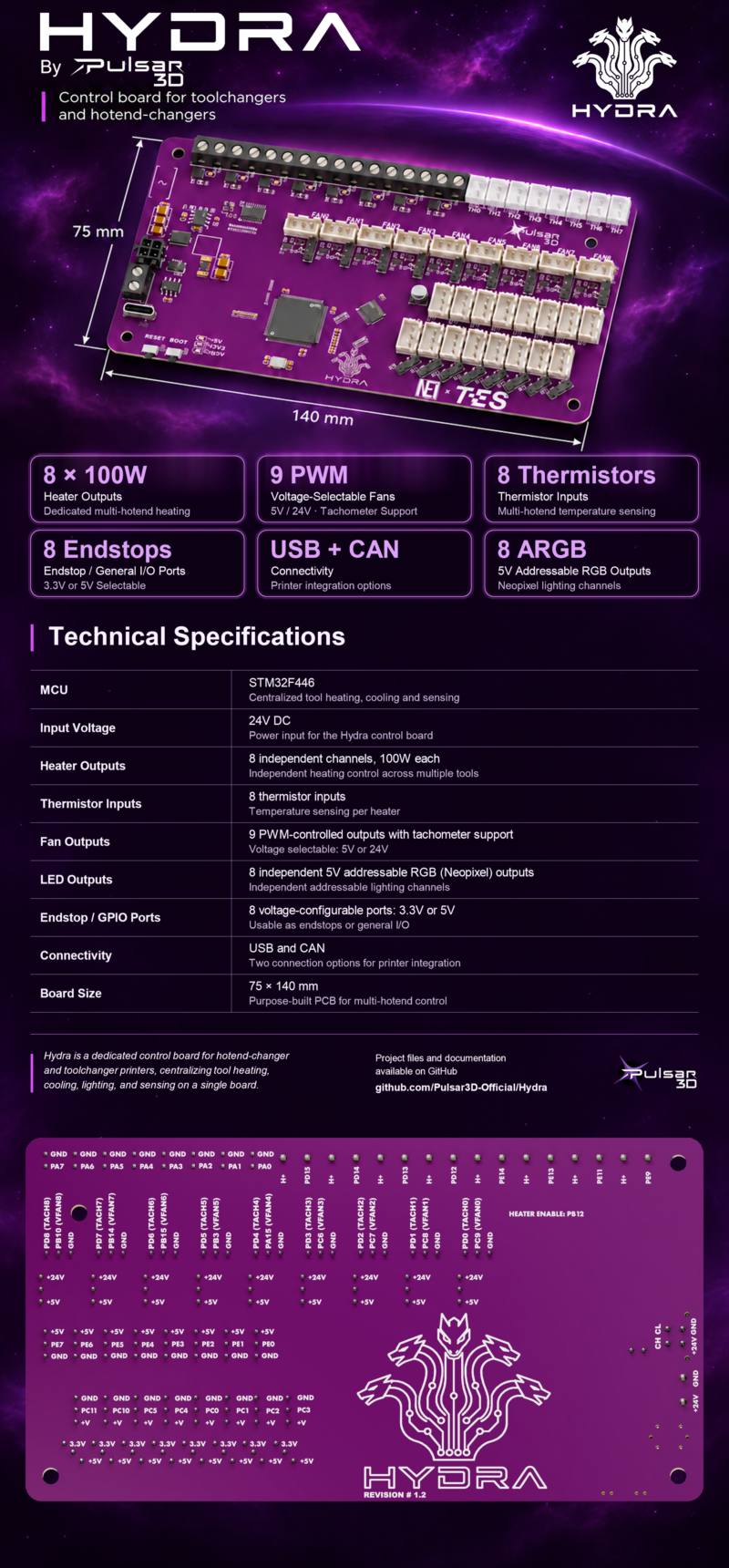
- 8 × 100W heater outputs with 8 thermistor inputs
- 9 PWM fan outputs with tachometer, 5V or 24V selectable
- 8 addressable RGB (Neopixel) outputs
- 8 endstop / GPIO ports, 3.3V or 5V selectable
- Connects over CAN or USB
One board for your whole tool rack
Multi-hotend printers usually mean a pile of small boards, one per tool, each with its own wiring, firmware and CAN address. Hydra replaces them with a single purpose-built controller. Built around an STM32F446 and powered from 24V, it gives every hotend its own heater output, thermistor input, fan, LED channel and sensor port, all managed as one MCU in Klipper.
What it handles
- Up to 8 hotends. Eight independent heater channels rated at 100W each, paired with eight thermistor inputs for per-tool temperature control.
- Up to 9 fans. One PWM output per tool plus a spare, each with tachometer feedback so Klipper can read fan speed. Fan voltage is selectable between 5V and 24V, so you can run whichever fans your tools use.
- Up to 8 LED chains. Eight independent 5V addressable RGB (Neopixel) outputs for per-tool status or work lighting.
- 8 endstop ports. Wire in filament sensors, dock detection or whatever per-tool sensing your build needs. Voltage is selectable between 3.3V and 5V to match your sensors, and the ports can also be used as general I/O.
- CAN or USB. Connects to your host however your build is already wired.
Built for Klipper
Hydra runs Klipper firmware and is set up as an additional MCU alongside your existing mainboard. Pulsar3D’s GitHub repository includes:
- An example Klipper config with all eight heaters, fans, sensors and Neopixel outputs already mapped to the right pins
- Step-by-step flashing guides for CAN with Katapult, USB with Katapult, and plain USB
- Printable mounts and DIN rail clips (STL) plus CAD files
On-board RESET and BOOT buttons put the board into DFU mode for flashing. Every pin is labelled on the rear silkscreen, which makes config work and fault-finding much quicker.
Who it’s for
Makers building a new multi-hotend machine, or upgrading an existing hotend changer, who want one purpose-built board in charge of every tool.
Technical specifications
| MCU | STM32F446 |
|---|---|
| Input voltage | 24V DC |
| Heater outputs | 8 independent channels, 100W each |
| Thermistor inputs | 8 |
| Fan outputs | 9 PWM outputs with tachometer support, 5V or 24V selectable |
| LED outputs | 8 independent 5V addressable RGB (Neopixel) |
| Endstop / GPIO ports | 8, voltage selectable 3.3V or 5V |
| Connectivity | USB-C and CAN |
| Firmware | Klipper (Katapult bootloader optional) |
| Board size | 140 × 75 mm |
| SKU | P3D-HYDRA |
Documentation
Full documentation, example config, flashing guides and project files are on Pulsar3D’s GitHub.
Please note
- USB cable not included.
- The board needs Klipper flashing before first use. Follow the flashing guide on GitHub.
- Hydra controls heaters, fans, LEDs and sensors only. Stepper drivers for extruders and motion stay on your mainboard or toolhead boards.
- Check heater, fan and sensor voltages against your build before powering up.



Reviews
There are no reviews yet.